INGREDIENT SCIENCE
Best Ingredients for Hyperpigmentation and Dark Spots
June 5, 2025
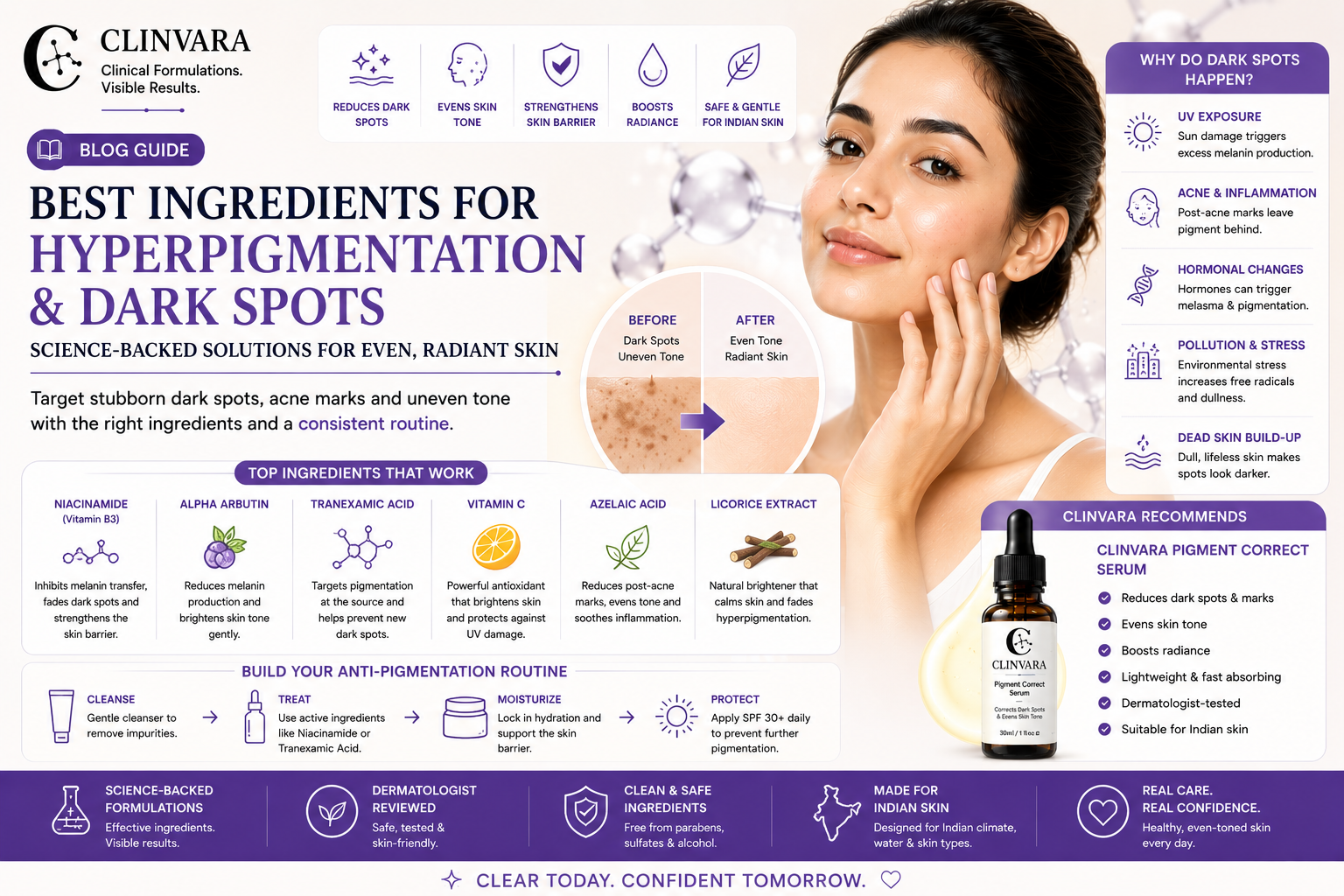
Discover the most effective ingredients for hyperpigmentation, dark spots, and uneven skin tone. Dermatologist-reviewed guide for Indian skin types with routine tips and product recommendations.
## Introduction Hyperpigmentation — the darkening of patches of skin due to excess melanin — is one of the most prevalent and persistent skincare concerns in India. It affects people of all ages, genders, and skin types, but is disproportionately common in darker skin tones due to the natural abundance and reactivity of melanocytes in Fitzpatrick types IV–VI, which encompass the majority of the Indian population. The causes range from sun exposure and hormonal shifts to post-acne marks and friction. Understanding the type of pigmentation you are dealing with is the first step towards treating it effectively. This guide covers the major causes, the most evidence-backed ingredients for treatment, and how to build a routine that delivers genuine, lasting results — including how CLINVARA's Deep Pigmentation Cream fits into a complete treatment approach.
## What Causes Hyperpigmentation? Melanin — the pigment responsible for skin colour — is produced by specialised cells called melanocytes. When melanocytes are triggered by inflammation, UV radiation, or hormonal signals, they produce excess melanin, which accumulates unevenly in the skin and creates visible dark patches. Key triggers include: - UV radiation — activates melanocytes as a protective response - Inflammation — any skin injury or irritation can trigger excess melanin production - Hormonal changes — particularly estrogen and progesterone fluctuations - Certain medications — including some antibiotics and hormonal contraceptives - Heat — standalone trigger that can worsen pigmentation - Friction — repeated rubbing from clothing or habits
## Types of Hyperpigmentation **Post-Inflammatory Hyperpigmentation (PIH)** PIH is the most common type in Indian consumers. It occurs after skin trauma — acne, cuts, burns, insect bites, or any inflammatory skin condition. The inflammation triggers melanocyte activity, leaving behind a dark mark even after the original injury has healed. PIH tends to appear brown to black on the skin surface (epidermal PIH) or can have a grey-blue tinge if melanin deposits deeper into the dermis (dermal PIH). Epidermal PIH is more responsive to topical treatment; dermal PIH requires more time and often professional intervention. **Sun Damage and Solar Lentigines** Chronic sun exposure causes uneven melanin distribution and the formation of solar lentigines — commonly called sun spots or age spots. In India, where UV radiation is intense year-round (UV index frequently exceeds 10 from March to September in most states), cumulative sun damage is a significant contributor to uneven skin tone in adults over 30. **Melasma** Melasma is a hormonally driven form of hyperpigmentation that typically appears symmetrically on the forehead, cheeks, upper lip, and chin. It is significantly more common in women and is frequently triggered or worsened by sun exposure, pregnancy, and oral contraceptive use. Melasma is among the most challenging forms of hyperpigmentation to treat, as it tends to recur even after successful lightening. A combination approach using topical ingredients alongside rigorous photoprotection and sometimes prescription therapies is typically required.
## The Best Research-Backed Ingredients for Hyperpigmentation **Niacinamide (Vitamin B3)** Niacinamide inhibits the transfer of melanin-containing vesicles from melanocytes to surrounding skin cells. At concentrations of 5–10%, it produces statistically significant reductions in hyperpigmentation within 8–12 weeks of consistent use. It is well tolerated across all skin types, making it suitable as a daily-use brightening agent in any pigmentation routine. **Vitamin C (Ascorbic Acid and Derivatives)** Vitamin C directly inhibits tyrosinase — the enzyme responsible for melanin synthesis. It also provides antioxidant protection against UV-induced pigmentation, and brightens the complexion by reducing existing oxidised melanin. L-ascorbic acid (pure vitamin C) is the most studied form but can be unstable and irritating at high concentrations. Stabilised derivatives such as ascorbyl glucoside, sodium ascorbyl phosphate, and ethyl ascorbic acid offer comparable benefits with greater stability and tolerability. **Azelaic Acid** Azelaic acid is a naturally occurring dicarboxylic acid that inhibits tyrosinase activity and has additional anti-inflammatory and antibacterial properties. It is particularly well suited to post-inflammatory hyperpigmentation and melasma. Available at 10% over the counter and 15–20% by prescription in some regions, azelaic acid is one of the few brightening agents considered safe in pregnancy and while breastfeeding (consult your doctor before use). **Retinoids (Retinol, Retinal, Tretinoin)** Retinoids work on pigmentation through multiple mechanisms: they accelerate cell turnover (which helps shed pigmented cells faster), inhibit tyrosinase, and interrupt melanin transfer. Tretinoin (prescription-only) is the most studied and effective retinoid for hyperpigmentation. Over-the-counter retinol and retinal offer a more gradual approach with a lower risk of initial irritation. Retinoids require careful introduction — start low (0.025–0.05% retinol), use only at night, and pair with a ceramide moisturiser to manage the initial purge and dryness phase. **Kojic Acid** Derived from fungi and a by-product of certain fermentation processes, kojic acid inhibits tyrosinase activity. It is often used in combination formulas targeting hyperpigmentation. Some individuals may find it slightly irritating at higher concentrations; formulations combining kojic acid with soothing agents are preferable. **Alpha Arbutin** Alpha arbutin is a glycosylated form of hydroquinone that inhibits tyrosinase without the potential side effects associated with hydroquinone itself. It is safe for daily use and effective at concentrations of 1–2%, making it a popular ingredient in brightening serums.
## The Non-Negotiable Role of Sunscreen Every dermatologist and every evidence-based skincare guide reaches the same conclusion: brightening ingredients are largely ineffective if you are not protecting your skin from UV radiation daily. Sunscreen is not simply protective — it is an active treatment component in any pigmentation protocol. UV radiation stimulates melanocyte activity. Without consistent photoprotection, any pigmentation gains made by topical brightening ingredients will be reversed by continued UV exposure. In India's high UV environment, this is non-negotiable. Use a broad-spectrum (UVA + UVB) SPF 30–50 sunscreen every morning, rain or shine, and reapply every 2–3 hours if outdoors.
## Recommended Skincare Routine for Hyperpigmentation **Morning Routine** - Gentle cleanser — avoid harsh foaming formulas - Antioxidant serum — vitamin C or niacinamide-based - CLINVARA Deep Pigmentation Cream — apply to affected areas before SPF - Broad-spectrum SPF 30–50 sunscreen — this step cannot be skipped **Evening Routine** - Double cleanse if wearing SPF or makeup - Niacinamide serum — for daily brightening support - Targeted treatment — azelaic acid or retinoid (not both on the same night) - Ceramide moisturiser — to support barrier health during active treatment The CLINVARA Deep Pigmentation Cream is formulated with a clinical blend of proven brightening actives designed specifically for the melanin-rich skin tones common across South Asia. It works on epidermal hyperpigmentation, targeting PIH and uneven skin tone, and is suitable for daily use as part of a comprehensive pigmentation management protocol.
## Mistakes That Worsen Hyperpigmentation - Picking at acne or spots — introduces trauma that triggers more PIH - Skipping sunscreen — the single most counter-productive habit in pigmentation treatment - Using too many brightening actives simultaneously — can irritate the skin and worsen PIH - Expecting results in days — most brightening ingredients require 8–12 weeks of consistent use - Using harsh physical scrubs — microtrauma triggers PIH in darker skin tones
## Conclusion Hyperpigmentation in Indian skin requires a methodical, patient, and evidence-led approach. No single ingredient is a magic solution — effective treatment combines the right active ingredients, rigorous daily sun protection, and consistency over time. Understanding the type of pigmentation you are dealing with helps set realistic expectations and guides ingredient selection. For most Indian consumers, a routine combining niacinamide, a stable vitamin C, sunscreen, and a targeted treatment like CLINVARA Deep Pigmentation Cream will deliver meaningful, visible improvement in 8–12 weeks. The goal is not instant transformation but a gradual, sustainable evening of skin tone that reflects real skin health.
## FAQ **Q: What is the fastest ingredient for removing dark spots?** No ingredient removes dark spots overnight. The fastest-acting evidence-backed approach typically combines tretinoin (prescription retinoid) with niacinamide and daily sunscreen, producing visible results in 6–8 weeks. Over-the-counter options like azelaic acid, vitamin C, and niacinamide are gentler and require 8–12 weeks. **Q: Is hydroquinone safe for Indian skin?** Hydroquinone is a potent depigmenting agent and is available by prescription in India. While effective, it carries risks of ochronosis (a blue-black discolouration) with prolonged use in high concentrations. It is typically recommended for short courses (3–6 months) under medical supervision. Safer daily-use alternatives include niacinamide, azelaic acid, and alpha arbutin. **Q: Can dark spots return after treatment?** Yes, particularly for hormonally driven melasma and sun damage. Daily SPF use and maintenance treatment (typically continued use of niacinamide or other brightening ingredients at lower frequency) are essential for maintaining results. **Q: Is it safe to use vitamin C and niacinamide together?** Yes. Concerns about this combination are largely outdated. They can be layered in the same routine or used in alternating morning/evening protocols — both approaches are safe and effective. **Q: How do I know if my pigmentation is epidermal or dermal?** Epidermal pigmentation typically appears brown and responds well to topical treatments. Dermal pigmentation appears grey-blue and is less responsive to topicals. A Wood's lamp examination by a dermatologist can definitively identify the depth of pigmentation.
Shop Related Products
Formulas connected to this article's core skin concern and routine guidance.
Back to all journal articles