INGREDIENT SCIENCE
Ceramides vs Hyaluronic Acid: Which Does Your Skin Need?
June 8, 2025
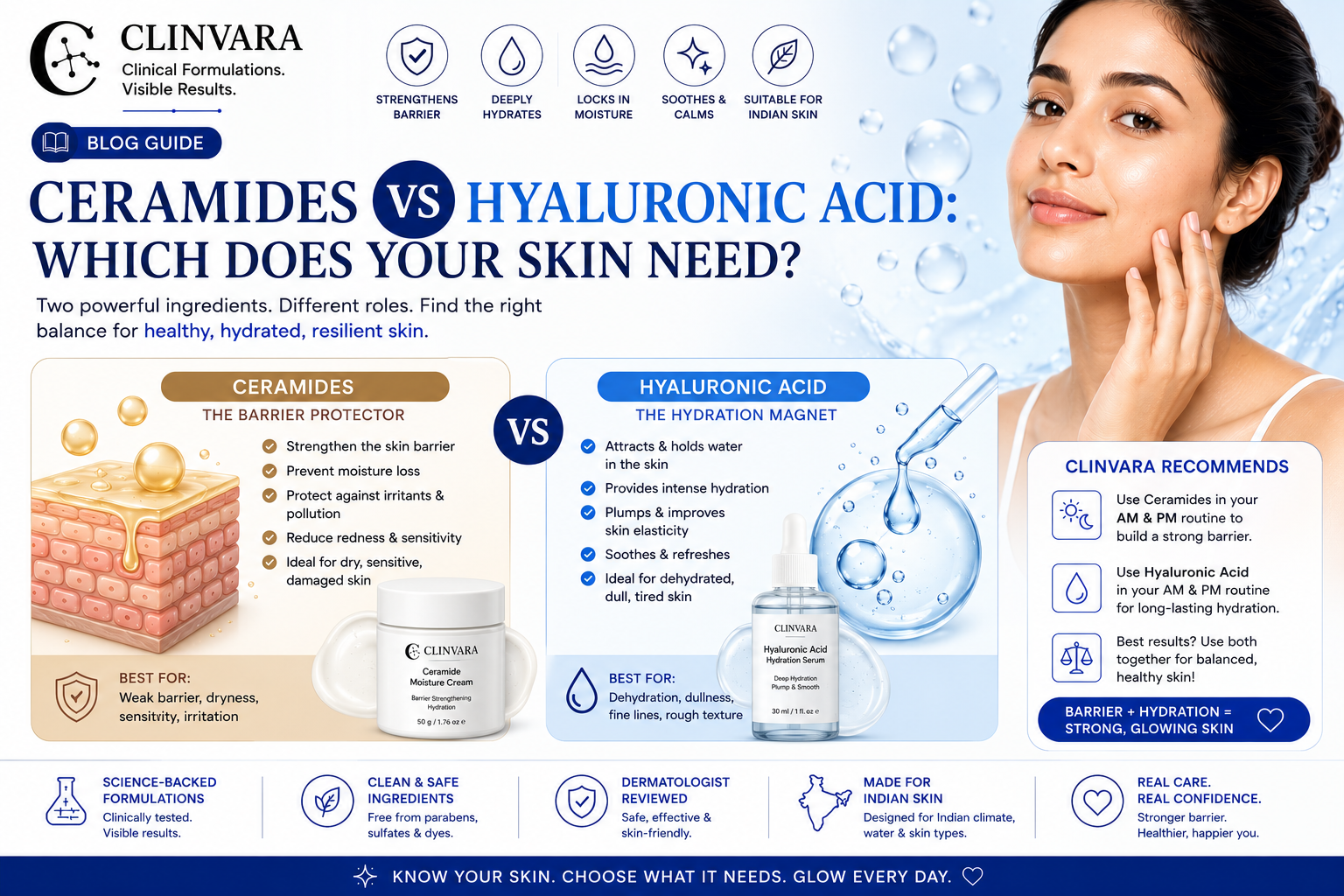
Ceramides vs hyaluronic acid: understand the difference, when to use each, and how to combine them for optimal hydration and barrier health. Expert skincare guidance for dry and dehydrated Indian skin.
## Introduction In the world of skincare, few ingredients generate as much discussion as ceramides and hyaluronic acid. Both are associated with skin hydration and health, both appear in some of the most acclaimed moisturisers and serums on the market, and both are genuinely supported by robust scientific evidence. Yet they work through fundamentally different mechanisms — and confusing the two can lead to skincare routines that address the wrong problem. Understanding the difference between ceramides and hyaluronic acid is not merely academic. For Indian consumers navigating dry winters, humid monsoons, air-conditioned environments, and the general demands of daily skincare, knowing which ingredient your skin actually needs — and when — can meaningfully improve your results.
## What Are Ceramides? Ceramides are lipid (fat) molecules that naturally exist in the stratum corneum — the outermost layer of the skin. They constitute approximately 50% of the skin's lipid matrix, which also includes cholesterol and free fatty acids. Together, these lipids form the mortar between skin cells, creating a physical barrier that: - Prevents transepidermal water loss (TEWL) - Blocks entry of pollutants, bacteria, and allergens - Maintains the skin's natural pH around 4.5–5.5 - Provides the structural integrity of the barrier When ceramide levels decline — due to ageing, over-exfoliation, harsh cleansers, UV damage, or environmental stress — this lipid matrix weakens, gaps form between skin cells, and both moisture loss and irritant entry increase. Topical ceramides replenish the skin's own lipid stores, physically restoring the barrier. They do not just sit on the skin's surface — they integrate into the existing lipid structure and functionally reinforce it.
## What Is Hyaluronic Acid? Hyaluronic acid (HA) is a glycosaminoglycan — a type of sugar molecule — that occurs naturally in the skin, joints, and connective tissues. In the skin, it is primarily found in the dermis, where it binds to water molecules and provides volume and elasticity. HA is a humectant, meaning its primary function is to attract and retain water. A single gram of hyaluronic acid can hold up to six litres of water. When applied topically, it draws moisture from the deeper layers of the skin and from the surrounding environment into the epidermis, creating visible plumping and hydration. There are multiple molecular weights of hyaluronic acid used in skincare: - **High molecular weight HA** — sits on the skin's surface, providing an immediate plumping effect and reducing TEWL - **Low molecular weight HA** — penetrates more deeply, hydrating the upper dermal layers - **Hydrolysed HA** — the smallest fragments, which can reach the deeper epidermis Many high-quality serums combine multiple molecular weights for both immediate and longer-lasting hydration benefits.
## Key Differences Between Ceramides and Hyaluronic Acid **Function** Ceramides repair and rebuild the structural lipid barrier. Hyaluronic acid attracts and binds water. One is a builder; the other is a moisture magnet. **What They Address** Ceramides address barrier dysfunction — skin that is structurally compromised and leaking moisture. Hyaluronic acid addresses dehydration — skin that lacks adequate water content, which may be structurally sound but simply thirsty. **Skin Types** Ceramides are critical for dry, sensitive, eczema-prone, and barrier-compromised skin. Hyaluronic acid benefits virtually all skin types, including oily and combination, as hydration is distinct from oiliness. **Product Formats** Ceramides are most effective in richer formulations — creams and lotions — because they need to be delivered within a lipid base to integrate with the skin's own lipid matrix. Hyaluronic acid is water-soluble and works well in lightweight serums, essences, and gels.
## When to Prioritise Ceramides Choose ceramide-focused products when you experience: - Persistent dryness and tightness, especially after cleansing - Skin that stings or reacts to products it previously tolerated - Visible flakiness or rough texture - Redness or blotchiness without an obvious cause - Breakouts despite dry skin (a paradoxical barrier damage sign) - Recovering from over-exfoliation or retinoid-induced irritation The CLINVARA Ceramide Moisture is formulated with a clinical ceramide complex designed to restore barrier lipids in a lightweight, non-comedogenic base — making it appropriate year-round and suitable for use across the range of Indian climate conditions.
## When to Prioritise Hyaluronic Acid Prioritise hyaluronic acid when you experience: - Skin that feels tight but not flaky — a sign of dehydration without severe barrier damage - Skin that looks dull or lacks plumpness despite being well-moisturised - Oily skin that still feels dehydrated — a surprisingly common combination - Need for a lightweight hydration layer under makeup or sunscreen - Air-conditioned environments or low-humidity settings that deplete surface moisture CLINVARA's NMF + HA Cleanser incorporates hyaluronic acid and natural moisturising factors directly into the cleansing step, helping the skin retain hydration even as it is being cleansed — a clinically considered approach that minimises the moisture disruption typically caused by cleansing.
## Can They Be Used Together? Yes — and in fact, ceramides and hyaluronic acid are among the most synergistic combinations in skincare. The logic is elegant: Hyaluronic acid draws water into the skin. Ceramides seal the barrier so that water cannot escape. Applied together — humectant first, then ceramide moisturiser — you both hydrate and lock in that hydration. Using hyaluronic acid without a ceramide or occlusive barrier on top can paradoxically draw moisture out of the skin in very low-humidity environments (such as air-conditioned rooms or dry northern Indian winters). The ceramide sealing step is therefore essential.
## Best Routine Combinations **For Dry or Barrier-Compromised Skin** - Cleanse with CLINVARA NMF + HA Cleanser (gentle, hydration-preserving) - Apply hydrating toner or hyaluronic acid serum on damp skin - Seal with CLINVARA Ceramide Moisture - Apply SPF in the morning **For Oily or Combination Skin** - Cleanse with CLINVARA NMF + HA Cleanser - Apply lightweight HA serum or essence - Apply a lightweight ceramide moisturiser — don't skip this step - Apply SPF in the morning — non-comedogenic formula preferred **For Dehydrated but Otherwise Healthy Skin** - Apply a multi-molecular-weight HA serum on damp skin - Follow with a lightweight ceramide moisturiser to lock in moisture - SPF in the morning
## Common Mistakes **Applying HA on dry skin in low-humidity environments** Without ambient moisture to draw from, HA may pull moisture from deeper skin layers, worsening dehydration. Always apply HA to damp skin and follow with an occlusive or ceramide-based product. **Using ceramide products without layering hydration first** Ceramides seal, but they need something to seal in. Apply humectants first, then ceramides. **Assuming moisturiser eliminates the need for HA serum** Many moisturisers contain both HA and ceramides, but standalone HA serums allow more targeted and concentrated hydration delivery, particularly for very dehydrated skin. **Skipping ceramides on oily skin** Oily skin still needs barrier lipid support. Lightweight ceramide formulations will not cause congestion and will support overall skin health regardless of sebum levels.
## Conclusion Ceramides and hyaluronic acid are not competitors — they are partners in skin health, addressing complementary aspects of the same goal: well-hydrated, structurally sound, resilient skin. Understanding their distinct roles helps you use both more intelligently, and the combination of the two is genuinely one of the most effective pairings in evidence-based skincare. For Indian consumers, where skin faces the dual challenge of environmental stress and the tendency to oscillate between oily and dehydrated depending on season and climate zone, this combination is particularly valuable. CLINVARA's Ceramide Moisture and NMF + HA Cleanser are formulated to work together as part of a cohesive barrier-health system — delivering both the lipid replenishment and hydration your skin needs across all conditions.
## FAQ **Q: Which is better for anti-ageing — ceramides or hyaluronic acid?** Both contribute to a youthful appearance but through different mechanisms. HA provides plumping and volume; ceramides maintain structural barrier integrity. For comprehensive anti-ageing benefits, use both in combination alongside retinoids and SPF. **Q: Can I use ceramide cream and HA serum in the same routine?** Absolutely. Apply HA serum first on damp skin, then seal with your ceramide moisturiser. This is the optimal application order. **Q: Is hyaluronic acid safe for acne-prone skin?** Yes. HA is non-comedogenic and does not contribute to breakouts. Ensure you choose a lightweight HA serum without pore-clogging oils or silicones in the base formula. **Q: Why does my skin feel more dehydrated after applying HA?** This typically occurs when HA is applied to completely dry skin in a low-humidity environment. Apply HA to slightly damp skin and always follow with a ceramide moisturiser to seal in the hydration.
Shop Related Products
Formulas connected to this article's core skin concern and routine guidance.
Back to all journal articles