SKIN HEALTH
How to Repair a Damaged Skin Barrier: Complete Guide
June 1, 2025
Learn how to repair a damaged skin barrier with expert tips on ceramides, hydration, and a daily routine. Dermatologist-backed advice for Indian skin types navigating pollution, UV exposure, and seasonal extremes.
## Introduction Your skin is your body's first line of defence against the environment — pollutants, UV radiation, bacteria, and harsh weather. At the heart of this defence system is the skin barrier, a microscopic but incredibly important structure that keeps moisture in and irritants out. When it is functioning optimally, skin looks plump, calm, and resilient. When it is damaged, you experience dryness, redness, sensitivity, and a general sense that nothing in your skincare routine is working. In India, where consumers navigate extreme humidity in coastal cities, dry winters in northern plains, high UV exposure year-round, and rapidly increasing air pollution, the skin barrier faces constant challenge. This guide explains what the skin barrier is, how to know when it is compromised, what causes damage, and exactly how to repair it — including the role of ceramides and how CLINVARA's formulations are designed with barrier health at their core.
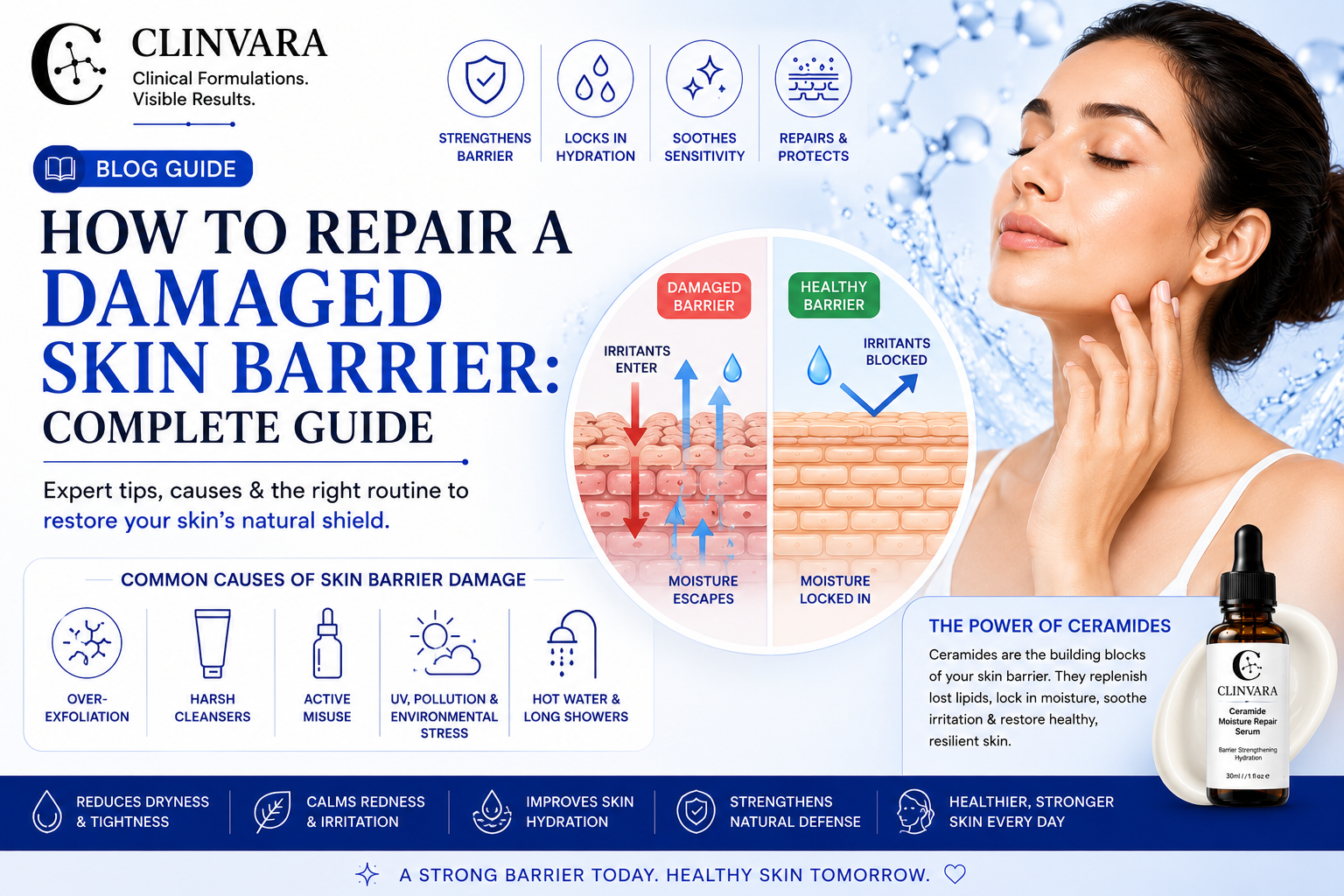
## What Is the Skin Barrier? The skin barrier, medically known as the stratum corneum, is the outermost layer of the epidermis. Think of it as a brick wall: skin cells (corneocytes) are the bricks, and lipids — including ceramides, cholesterol, and free fatty acids — are the mortar holding everything together. This structure performs several essential functions: - Prevents transepidermal water loss (TEWL), keeping skin hydrated - Blocks environmental irritants, allergens, and pollutants - Acts as a first-line immune defence against bacteria and fungi - Maintains an optimal skin pH of around 4.5 to 5.5 When this lipid matrix is disrupted, gaps form between the skin cells. Water escapes, and harmful substances enter more easily — creating a cycle of dryness, inflammation, and sensitivity.
## Signs of a Damaged Skin Barrier Barrier damage can be subtle or obvious. Watch for these indicators: **Persistent Dryness and Tightness** If your skin feels tight after cleansing or throughout the day — even after applying moisturiser — this is a classic sign of barrier disruption and elevated TEWL. **Redness and Inflammation** A compromised barrier allows inflammatory triggers to penetrate more deeply, leading to visible redness, flushing, or blotchy patches. **Increased Sensitivity** Products that previously caused no issues suddenly sting, tingle, or cause breakouts. This is your skin telling you its defences are down. **Rough or Flaky Texture** Accelerated shedding of damaged skin cells combined with impaired moisture retention produces a rough, uneven surface that can feel sandpaper-like. **Breakouts Despite Dry Skin** A damaged barrier can paradoxically lead to congestion. When bacteria and irritants enter more easily, inflammation rises — and with it, the risk of acne.
## Common Causes of Skin Barrier Damage **Over-Exfoliation** Exfoliation — both physical scrubs and chemical acids like AHAs and BHAs — is beneficial when used correctly. However, daily or aggressive exfoliation strips the lipid layer and disrupts cell turnover. Many Indian consumers unknowingly over-exfoliate in pursuit of brighter skin, resulting in barrier damage. Limit exfoliation to 2–3 times per week at most, and always follow with a barrier-supporting moisturiser. **Harsh Cleansers** High-pH foaming cleansers and soaps are among the most common causes of barrier damage. They disrupt the skin's natural acid mantle, leaving it alkaline and vulnerable. Look for pH-balanced, sulfate-free cleansers instead. **Active Ingredient Misuse** Retinoids, high-concentration vitamin C, and strong acids are powerful but must be introduced gradually. Using too many actives simultaneously — or jumping straight to high concentrations — overwhelms the skin and breaks down its protective layers. **Environmental Stress** India's climate presents unique challenges. Hard water high in mineral content strips natural oils. Air conditioning and heating create artificial dryness. UV radiation, particularly intense between March and October across most of India, degrades barrier lipids and accelerates moisture loss. Pollution particles attach to the skin surface, generating free radicals that damage lipid structures. **Hot Water and Long Showers** Hot water dissolves the skin's lipid layer far more efficiently than warm or cool water. Long showers compound the effect, leaving skin stripped and susceptible to TEWL.
## How Ceramides Help Repair the Skin Barrier Ceramides are lipid molecules that make up approximately 50% of the skin's lipid matrix. They are essential for maintaining barrier integrity and preventing moisture loss. As we age, and when the barrier is damaged, ceramide levels naturally decline. Topical ceramides work by replenishing this lipid matrix. Clinical research has consistently demonstrated that ceramide-containing formulations: - Significantly reduce TEWL within 2–4 weeks of consistent use - Improve skin hydration and elasticity - Reduce inflammatory skin conditions associated with barrier dysfunction, including atopic dermatitis - Support the recovery of skin pH towards its optimal range The CLINVARA Ceramide Moisture is formulated with a dermatologist-reviewed blend of ceramides, designed to restore the lipid matrix that keeps Indian skin healthy through seasonal transitions and daily environmental exposure. Its non-comedogenic, lightweight texture makes it suitable across skin types — from dry to combination — without causing congestion.
## The Role of Hydration in Barrier Repair Hydration and barrier repair are closely linked but distinct concepts. While ceramides and lipids seal the barrier, humectants draw water into the skin. Ingredients like hyaluronic acid, glycerin, and niacinamide help maintain optimal moisture levels in the upper skin layers, creating a plump, resilient surface that supports healing. The key principle is layering: apply humectants first on damp skin, then seal with a ceramide-rich moisturiser. This combination addresses both moisture attraction and retention — two critical aspects of barrier recovery.
## Daily Barrier Repair Routine **Morning Routine** - Gentle, pH-balanced cleanser (avoid foaming sulfate-based formulas) - Hydrating toner or essence with hyaluronic acid or glycerin - Lightweight serum if needed — avoid actives during active barrier repair - CLINVARA Ceramide Moisture to seal and protect - Broad-spectrum SPF 30–50 sunscreen (non-negotiable — UV worsens barrier damage) **Evening Routine** - Double cleanse if you wear sunscreen or makeup — oil cleanser first, then gentle water-based cleanser - Humectant toner or essence - CLINVARA Ceramide Moisture — apply liberally as the final step - Consider a sleeping mask or occlusive balm on very damaged areas
## Mistakes to Avoid During Barrier Repair - Introducing new actives or exfoliants while the barrier is compromised - Using alcohol-based toners or astringents - Skipping sunscreen — UV radiation is a primary driver of ongoing barrier damage - Over-washing the face — twice daily is sufficient for most skin types - Using fragrant products, which can be irritating to a sensitised barrier - Expecting overnight results — barrier repair typically takes 2–4 weeks of consistent care
## Recommended Ingredients for Barrier Repair When selecting products during barrier recovery, prioritise these clinically validated ingredients: - **Ceramides (types NP, AP, EOP)** — lipid replenishment - **Cholesterol** — essential barrier lipid, often underrated - **Niacinamide (at 2–5%)** — strengthens barrier, reduces inflammation - **Hyaluronic acid** — humectant for moisture retention - **Glycerin** — effective, affordable humectant - **Panthenol (vitamin B5)** — accelerates skin repair and soothes irritation - **Allantoin** — calms sensitivity and promotes cell renewal Avoid: alcohol denat, fragrance (parfum), strong essential oils, and high concentrations of AHAs/BHAs during the recovery phase.
## Conclusion A healthy skin barrier is the foundation of effective skincare. Without it, no serum, no treatment, and no active ingredient will perform as intended. For Indian consumers dealing with pollution, seasonal extremes, and the cultural pressure for glowing skin that often leads to over-exfoliation, barrier health deserves more attention than it typically receives. The path to repair is simple but requires consistency: strip back your routine, introduce ceramide-rich moisturisers, prioritise hydration, and give your skin the time it needs to rebuild. Products like the CLINVARA Ceramide Moisture are formulated precisely for this purpose — clinically considered, appropriate for Indian skin types, and designed for real-world conditions.
## FAQ **Q: How long does it take to repair a damaged skin barrier?** Most people begin to notice improvement within 1–2 weeks of consistent barrier-focused care, with significant recovery typically occurring within 4–6 weeks. Severely compromised barriers may take longer. Consistency is more important than product quantity. **Q: Can I use niacinamide on a damaged skin barrier?** Yes — at concentrations of 2–5%, niacinamide is actually beneficial for barrier repair. It stimulates ceramide synthesis and reduces inflammation. Avoid very high concentrations (above 10%) until the barrier has improved. **Q: Is it normal for skin to purge when repairing the barrier?** True purging is associated with cell-turnover-boosting actives like retinoids and AHAs. If you are simply using a ceramide moisturiser and gentle cleanser, breakouts are unlikely to be purging — they may indicate the product is not suitable for your skin type. **Q: Should I stop all actives completely when my barrier is damaged?** Generally, yes — take a 2–4 week break from exfoliating acids, retinoids, and high-concentration vitamin C. Allow the barrier to recover before reintroducing actives gradually. **Q: Are ceramide products safe during pregnancy?** Ceramides are naturally occurring skin lipids and are considered safe for topical use during pregnancy. However, always consult your gynaecologist or dermatologist before making significant changes to your skincare routine during pregnancy. **Q: Can oily skin have a damaged barrier?** Absolutely. Oiliness and barrier health are independent. Many people with oily skin over-cleanse or over-exfoliate in an attempt to control sebum, which paradoxically damages the barrier. A compromised barrier can even stimulate more sebum production as the skin tries to compensate.
Shop Related Products
Formulas connected to this article's core skin concern and routine guidance.
Back to all journal articles