INGREDIENT SCIENCE
Niacinamide Benefits for Indian Skin: Everything You Need to Know
June 3, 2025
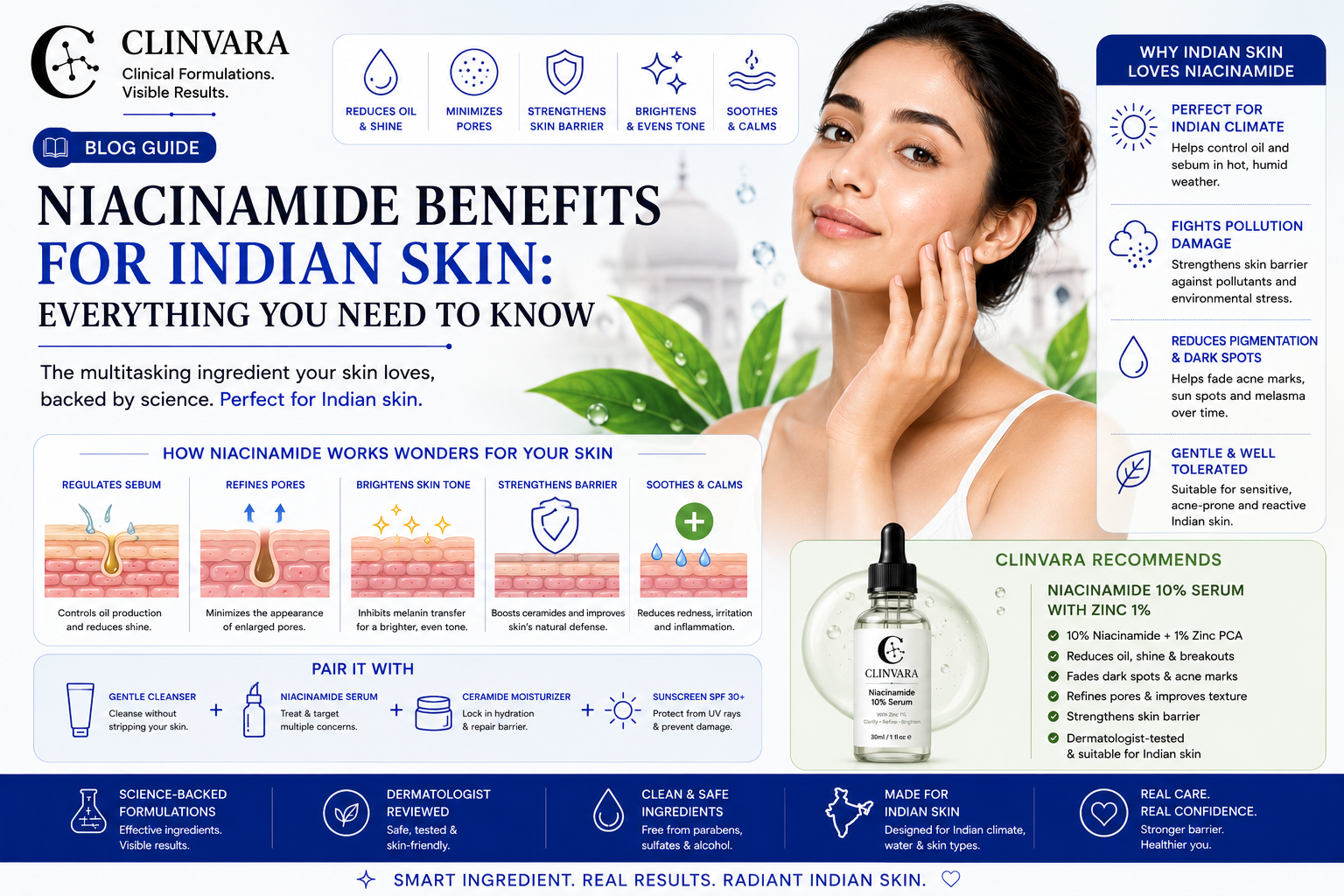
Discover science-backed niacinamide benefits for Indian skin: reduces pigmentation, controls oil, minimises pores, and strengthens the barrier. Expert guide with routine tips and product advice.
## Introduction Niacinamide has earned its place as one of the most researched and clinically validated skincare ingredients available today. Unlike many trending actives, niacinamide is supported by decades of peer-reviewed studies, is well tolerated across virtually all skin types, and addresses multiple common concerns simultaneously — making it particularly well suited to the diverse needs of Indian skin. Whether your primary concerns are dark spots from acne scarring, an oily T-zone, enlarged pores, or an uneven skin tone — all of which are among the most common skin concerns across India's climate zones — niacinamide offers clinically meaningful benefits. This article unpacks the science, practical application, and how CLINVARA's Niacinamide 10% Face Serum brings these benefits to an Indian skincare context.
## What Is Niacinamide? Niacinamide is the active, water-soluble form of vitamin B3. It functions as a coenzyme in numerous cellular processes, meaning it actively participates in the biochemical reactions that maintain skin health. Unlike some ingredients that primarily sit on the skin's surface, niacinamide penetrates the epidermis and influences skin function at a cellular level. It is not to be confused with nicotinic acid (another form of vitamin B3), which can cause a temporary skin flushing reaction. Niacinamide does not cause this response and is broadly considered one of the safest and most versatile skincare actives available.
## Scientific Benefits of Niacinamide for Skin **1. Reduces Hyperpigmentation and Dark Spots** This is perhaps the most discussed benefit of niacinamide for Indian skin. Research demonstrates that niacinamide inhibits the transfer of melanosomes (melanin-carrying vesicles) from melanocytes to surrounding keratinocytes. It does not inhibit melanin production directly, but by blocking this transfer, it prevents pigment from distributing unevenly across the skin surface. Clinical trials have shown that 5% niacinamide applied twice daily over 8 weeks produced statistically significant reductions in hyperpigmentation, skin yellowing, and blotchiness. At 10% concentration, effects are more pronounced and faster — making it especially relevant for post-inflammatory hyperpigmentation (PIH), which is disproportionately common in melanin-rich Indian skin types. **2. Controls Sebum Production** Niacinamide is one of the few topical ingredients shown in controlled studies to meaningfully regulate sebum excretion rate. A 2006 clinical study published in the Journal of Cosmetic and Laser Therapy found that 2% niacinamide reduced sebum production significantly after 4 weeks of use. For Indian skin — particularly in tropical and semi-arid climates where humidity and heat drive increased sebum activity — this is a meaningful benefit. Reduced excess oil also helps minimise the appearance of pores and prevents the greasy finish that many consumers in states like Kerala, Tamil Nadu, and Maharashtra struggle with through summer months. **3. Minimises the Appearance of Enlarged Pores** Pore size is determined largely by genetics and sebum production. While no ingredient can permanently shrink pores, niacinamide reduces the appearance of enlarged pores through two mechanisms: reducing sebum (which causes pores to appear stretched) and improving skin elasticity, which allows pore walls to remain firm. **4. Strengthens the Skin Barrier** Niacinamide stimulates the synthesis of ceramides and other skin-identical lipids within the stratum corneum. This directly strengthens the skin barrier, improving its ability to retain moisture and defend against environmental aggressors. For Indian consumers dealing with pollution and UV stress, this is a significant functional benefit. **5. Anti-Inflammatory and Calming** Niacinamide inhibits several pro-inflammatory mediators in the skin, reducing redness, irritation, and the inflammatory component of acne. This makes it appropriate for use alongside stronger actives like retinoids or acids — it helps offset their irritating side effects. **6. Antioxidant Properties** As a precursor to NAD+ and NADP+ — coenzymes critical to cellular energy and repair — niacinamide supports the skin's natural antioxidant defences. This helps mitigate oxidative stress from UV radiation and pollution, both of which are significant concerns in Indian urban environments.
## Niacinamide for Common Indian Skin Concerns **Pigmentation and Uneven Skin Tone** Post-inflammatory hyperpigmentation is among the most common concerns for Indian consumers. Acne marks, insect bites, friction, and even mild inflammation can leave behind dark spots that take months to fade unaided. Niacinamide accelerates this fading by blocking melanin transfer at concentrations of 5–10%. Consistent daily application over 6–12 weeks typically produces visible improvement. **Oily and Combination Skin** The humid climates of South India and the hot summers across the subcontinent make sebum control a priority for a significant proportion of Indian consumers. Niacinamide's ability to regulate oil without stripping the skin makes it an ideal active for daily use — unlike clay masks or harsh astringents, which can damage the barrier when used too frequently. **Acne Marks and Scarring** While niacinamide does not treat active acne directly (it is not an antibacterial), its anti-inflammatory properties reduce the severity of inflammatory acne lesions, and its melanin transfer-blocking action significantly reduces the PIH that follows. It is therefore valuable both during and after acne episodes. **Sensitive Skin** Niacinamide is one of the most tolerated skincare actives across skin types. Clinical studies have demonstrated its safety in concentrations up to 10% in most individuals. For those with reactive, eczema-prone, or rosacea-adjacent skin, niacinamide provides genuine functional benefits with a minimal risk profile — a relatively rare combination in active skincare.
## How to Use Niacinamide Effectively **Concentration** Research supports benefits at concentrations of 2–10%. At 2–5%, you will see improvements in sebum control and barrier support. At 5–10%, pigmentation benefits are more pronounced. The CLINVARA Niacinamide 10% Face Serum is formulated at the upper end of this range, targeting both pigmentation and oiliness with clinical-grade concentration. **Application** Apply niacinamide serum to clean, toned skin before heavier products such as moisturisers and SPF. It can be used morning and evening, though once daily is sufficient for most users. On damp skin, niacinamide absorbs more readily. **Patience and Consistency** Visible improvements in pigmentation typically require 6–8 weeks of consistent twice-daily use. Sebum control effects may be noticeable sooner, within 2–4 weeks. Do not expect overnight results — niacinamide works gradually and sustainably.
## Niacinamide Ingredient Combinations **Niacinamide + Sunscreen** The most important combination for pigmentation management. Niacinamide addresses existing pigment; sunscreen prevents new pigmentation from forming. Always use SPF 30–50 daily when using niacinamide for dark spots. **Niacinamide + Hyaluronic Acid** Complementary pairing. Hyaluronic acid provides deep hydration; niacinamide strengthens the barrier and reduces oil. Safe and effective to layer. **Niacinamide + Ceramides** Synergistic barrier support. Niacinamide stimulates ceramide production from within; topical ceramides replenish from the outside. This combination significantly accelerates barrier recovery. **Niacinamide + Retinoids** Niacinamide's anti-inflammatory properties make it an excellent buffer for the irritation commonly associated with retinoid use. Apply niacinamide first, allow it to absorb, then apply retinol or tretinoin. **Niacinamide + Vitamin C** Historically, concerns were raised about combining these two ingredients. This is largely a myth in the context of modern, stable formulations and normal skin temperatures. They can be used together or in alternating morning/evening routines without issue.
## Common Niacinamide Myths **Myth 1: Higher concentration is always better** Not necessarily. Most studies show benefit plateaus beyond 10%, and concentrations above 10% increase the risk of minor irritation without proportional additional benefit. Start at 5% and progress only if tolerated well. **Myth 2: Niacinamide causes flushing** This is associated with nicotinic acid, not niacinamide. Niacinamide does not trigger the prostaglandin-mediated flush response. **Myth 3: You need to avoid niacinamide with vitamin C** This concern is based on outdated chemistry. Modern formulations are stable, and any niacin conversion that occurs at skin temperature is negligible and clinically insignificant. **Myth 4: Niacinamide is only for oily skin** Niacinamide benefits all skin types through its barrier-supporting, anti-inflammatory, and brightening actions. It is one of the few actives truly appropriate across the full spectrum of skin types and conditions.
## Conclusion Niacinamide earns its reputation as a cornerstone active in evidence-based skincare, and for Indian skin specifically, its combination of pigmentation management, sebum regulation, pore refinement, and barrier support makes it uniquely versatile. It addresses the most common concerns in a single ingredient, with a safety and tolerability profile that few other actives can match. The CLINVARA Niacinamide 10% Face Serum is formulated to deliver this ingredient at therapeutic concentration with a texture and base that suits the humidity and climate conditions of daily Indian life. Whether you are managing PIH, persistent oiliness, or simply seeking an even, healthy complexion, niacinamide used consistently and correctly is one of the highest-return investments in your skincare routine.
## FAQ **Q: Is niacinamide safe to use every day?** Yes. Niacinamide is one of the safest daily-use skincare actives. Most individuals can use it twice daily without irritation, even on sensitive skin. **Q: How long before I see results from niacinamide?** Sebum control and skin texture improvements may be visible within 2–4 weeks. For pigmentation and dark spots, expect 6–12 weeks of consistent use for meaningful results. **Q: Can niacinamide cause breakouts?** Niacinamide itself is not comedogenic. Initial breakouts in the first 1–2 weeks of use may occur as the skin adjusts, but persistent breakouts suggest the product's base formula (not the niacinamide) may not suit your skin type. **Q: Can I use niacinamide if I have melasma?** Yes. Niacinamide is a useful adjunct treatment for melasma, particularly when combined with sunscreen and other brightening agents. However, melasma is a complex condition — consult a dermatologist for a comprehensive treatment plan. **Q: Is 10% niacinamide too strong for sensitive skin?** Some individuals with very reactive skin may prefer to start at 5% and build up. However, clinical data shows 10% niacinamide is tolerated by the large majority of users, including those with sensitive skin conditions.
Shop Related Products
Formulas connected to this article's core skin concern and routine guidance.
Back to all journal articles