INGREDIENT SCIENCE
Niacinamide vs Vitamin C — Which Should You Use (Or Can You Use Both)?
April 22, 2025
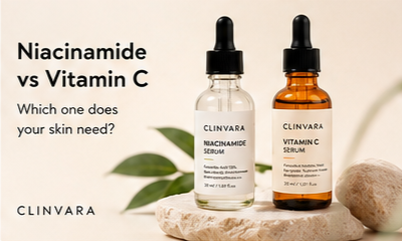
Niacinamide and vitamin C are two of the most researched actives in modern skincare. This guide breaks down what each one does, how they differ, and exactly how to use them together safely for brighter, clearer, more even skin.
## What Is Niacinamide? Niacinamide is a form of vitamin B3 — a water-soluble, highly stable ingredient that has become one of the most widely used actives in skincare. Unlike many ingredients that excel at one thing, niacinamide is genuinely multi-functional. **What niacinamide may help with:** - Reducing the appearance of enlarged pores - Regulating sebum production in oily and combination skin - Strengthening and supporting the skin barrier - Improving the appearance of uneven skin tone and mild hyperpigmentation - Reducing the look of redness and blotchiness - Improving skin texture and smoothness over time - Supporting the skin's natural ceramide production Niacinamide works partly by supporting the production of ceramides — lipids that are essential to a healthy skin barrier — and by influencing melanin transfer within the skin, which can help improve the appearance of dark spots with consistent use. It is well tolerated by most skin types, including sensitive and reactive skin. Concentrations between 5% and 10% are commonly used in serums. The CLINVARA Niacinamide 10% Face Serum uses a 10% concentration, which many people find delivers visible improvements to pore appearance, tone, and texture without excessive irritation.
## What Is Vitamin C? Vitamin C (most commonly used in skincare as L-ascorbic acid, or in more stable derivative forms such as ascorbyl glucoside or magnesium ascorbyl phosphate) is one of the most researched antioxidants in cosmetic science. **What vitamin C may help with:** - Protecting skin from oxidative damage caused by UV exposure and environmental pollution - Brightening overall skin tone and reducing the appearance of dullness - Improving the appearance of hyperpigmentation and dark spots - Supporting collagen synthesis, which may help the skin appear firmer and more youthful over time - Reducing the visible signs of environmental stress on skin - Enhancing the effectiveness of SPF by neutralising free radicals that UV filters do not address Vitamin C in its most potent form — L-ascorbic acid — works best at a low pH (typically 2.5–3.5), which makes it highly effective but also potentially irritating for sensitive skin types. More stable derivatives work at a higher pH and tend to be gentler, though they typically produce results more gradually. Vitamin C is particularly valuable in morning routines because of its antioxidant properties. Applied before SPF, it can help defend the skin against oxidative stress from UV and pollution throughout the day.
## Niacinamide vs Vitamin C — Key Differences | Feature | Niacinamide | Vitamin C | |--------|-------------|----------| | Skin type suitability | All types, especially oily and sensitive | All types; may irritate sensitive or reactive skin initially | | Primary benefits | Pore appearance, sebum, barrier, tone | Brightening, antioxidant, pigmentation, collagen support | | Stability | Very stable; not affected by light or air | L-ascorbic acid oxidises in light and air; derivatives are more stable | | pH dependency | Effective across a broad pH range | L-ascorbic acid requires low pH (2.5–3.5) | | Best time of day | Morning or evening | Morning (pairs best with SPF for antioxidant defence) | | Time to visible results | 4–8 weeks with consistent use | 4–6 weeks for brightening; longer for deeper pigmentation | | Irritation risk | Low; well tolerated by most | Moderate; higher concentrations of L-ascorbic acid can sting | | Barrier support | Direct — promotes ceramide production | Indirect — antioxidant protection supports skin health overall | | Sebum regulation | Yes — one of few ingredients shown to help | No direct effect on sebum | | Collagen support | Indirect | Direct — supports collagen synthesis |
## Can You Use Niacinamide and Vitamin C Together? Yes — and the old myth that combining them causes harmful reactions has been largely debunked by modern cosmetic research. The historical concern came from a theory that niacinamide and vitamin C could react to form nicotinic acid, which causes skin flushing. While this reaction is chemically possible, it requires sustained high temperatures well above anything your skin or bathroom will ever reach. In properly formulated products used at room temperature, this is not a meaningful concern for the vast majority of people. **Three ways to use them together:** *Option 1 — Different times of day (simplest approach)* Use vitamin C in the morning and niacinamide in the evening. This avoids any layering question entirely, leverages each ingredient where it works best, and works well for beginners or anyone with sensitive skin. *Option 2 — Same routine, layered in sequence* Apply vitamin C first on clean skin and wait 1–2 minutes before applying niacinamide. This gives the vitamin C time to interact with the skin at a lower pH before the next layer alters that environment. *Option 3 — Products that combine both* Some well-formulated products use stable vitamin C derivatives alongside niacinamide. These can be effective and remove the layering question entirely. **Who benefits most from combining both?** Anyone targeting hyperpigmentation often sees the most benefit from using both, since they address pigmentation through different biological pathways. Vitamin C targets oxidative stress and melanin synthesis, while niacinamide may help reduce melanin transfer within the skin and improve overall tone.
## Niacinamide vs Vitamin C — Which Is Better for Oily Skin? For oily skin, **niacinamide is generally the more directly targeted choice**. It is one of the few cosmetic ingredients with meaningful evidence for helping regulate sebum production, which can visibly reduce shine and help minimise the appearance of enlarged pores over time. Niacinamide also strengthens the skin barrier, which is more relevant for oily skin than it might seem. Harsh cleansers or over-exfoliation can disrupt the barrier and trigger compensatory oil production — a stronger barrier can help break this cycle. **Practical approach for oily skin:** - Apply the CLINVARA Niacinamide 10% Face Serum as a lightweight layer after cleansing, morning or evening - Follow with a non-comedogenic, lightweight moisturiser — do not skip moisturiser even if skin is oily - Add vitamin C in the morning for its antioxidant and brightening benefits - Choose an SPF formula labelled non-comedogenic Vitamin C is not problematic for oily skin, but it does not address sebum directly. It is a valuable addition to any routine regardless of skin type — its antioxidant properties benefit everyone.
## Niacinamide vs Vitamin C — Which Is Better for Sensitive Skin? For sensitive or reactive skin, **niacinamide is typically the gentler and safer starting point**. It rarely causes irritation, is not pH-dependent, and works well even on compromised or reactive skin. Vitamin C absolutely can be used on sensitive skin — the key is choosing the right form. Stable derivatives like ascorbyl glucoside or sodium ascorbyl phosphate are considerably gentler than high-concentration L-ascorbic acid serums, and many people with sensitive skin find them well tolerated. **For sensitive skin, consider this approach:** 1. Introduce niacinamide alone for the first 4–6 weeks — observe your skin's response 2. When ready to add vitamin C, choose a derivative form rather than a high-strength L-ascorbic acid formula 3. Introduce vitamin C every other day initially and build slowly 4. Always patch test on your inner arm before full-face application 5. If stinging or redness occurs with a vitamin C serum, try a different form before abandoning the ingredient entirely **Signs vitamin C may be too strong for your skin right now:** - Immediate stinging or burning on application - Persistent redness lasting more than 10–15 minutes - New breakouts or texture changes appearing shortly after introducing it
## Niacinamide vs Vitamin C — Which Is Better for Hyperpigmentation? Both can help improve the appearance of hyperpigmentation, but through different mechanisms — which is exactly why using both often produces better results than either alone. | Pigmentation Concern | Niacinamide | Vitamin C | |---------------------|-------------|----------| | Sun-induced dark spots | Moderate benefit | Strong benefit | | Post-inflammatory hyperpigmentation (acne marks) | Strong benefit | Moderate benefit | | Melasma | May help reduce appearance with consistent use | May help reduce appearance | | Overall skin brightening | Yes — gradual, even improvement | Yes — often faster visible brightness | | Preventing new pigmentation | Partial (barrier support reduces inflammation) | Yes — antioxidant defence limits UV-triggered melanin | For stubborn or deeper pigmentation, a dedicated treatment like the CLINVARA Deep Pigmentation Cream used alongside these serums can provide more comprehensive support by targeting pigmentation through additional pathways. **The SPF rule:** No topical ingredient will meaningfully address hyperpigmentation without consistent daily SPF. UV exposure is the primary driver of most forms of pigmentation. SPF must be part of any effective pigmentation routine — it is not optional.
## Niacinamide vs Vitamin C — Which Is Better for Beginners? **Niacinamide is generally the better first active for most beginners.** It is stable, forgiving, works across a wide range of skin types, and requires no special timing or application conditions. Vitamin C is accessible for beginners too, but requires a little more consideration — particularly around choosing between L-ascorbic acid and stable derivatives, and understanding that oxidised vitamin C (yellow or orange serum) has lost significant efficacy. **Beginner recommendation — 4-week phased approach:** Weeks 1–2: - Introduce niacinamide serum in the evening every other night - Cleanser + niacinamide + moisturiser + SPF (morning) Weeks 3–4: - Increase niacinamide to every night if comfortable - Assess skin — is texture improving? Is redness reducing? Week 5 onward: - Add a vitamin C serum to your morning routine - Start every other morning, build to daily over 2–3 weeks Beginner rules that apply regardless: - Never introduce more than one new product in the same week - Patch test on your inner arm before full-face use - Give each product at least 4 weeks before judging whether it is working
## Niacinamide vs Vitamin C — Side Effects and What to Watch For Both ingredients are generally safe and well-studied, but side effects can occur, particularly when introducing them to a new routine. **Niacinamide — possible side effects:** - Mild flushing or tingling in the first few uses at high concentrations (typically resolves quickly) - Very rarely, some people experience breakouts when first introducing niacinamide — this often resolves within 2–3 weeks - At extremely high concentrations (above 10%), some individuals report increased sensitivity **Vitamin C — possible side effects:** - Stinging or burning on application, especially with L-ascorbic acid formulas at 15–20% - Redness that may last 5–15 minutes after application - In rare cases, contact dermatitis — discontinue use if severe or persistent - Oxidised vitamin C products can cause staining or uneven application — discard if the serum is orange or brown **General rule:** If any product causes significant or persistent discomfort, remove it from your routine and allow your skin to settle before reintroducing it at a lower frequency or concentration.
## Morning Routine With Niacinamide and Vitamin C | Step | Product | Notes | |------|---------|-------| | 1 | Gentle cleanser | CLINVARA Natural Moisturizing Factors + HA Cleanser — non-stripping daily cleanser | | 2 | Toner or essence (optional) | Hydrating; not exfoliating | | 3 | Vitamin C serum | Apply to clean skin; wait 1–2 minutes | | 4 | Niacinamide serum | CLINVARA Niacinamide 10% Face Serum; layer after vitamin C | | 5 | Moisturiser | CLINVARA Ceramide Moisture for barrier support and hydration | | 6 | SPF 30–50 | Always last; always every day |
## Evening Routine With Niacinamide and Vitamin C | Step | Product | Notes | |------|---------|-------| | 1 | Cleanser | Double cleanse if wearing SPF or makeup | | 2 | Niacinamide serum | CLINVARA Niacinamide 10% Face Serum; primary evening active | | 3 | Pigmentation treatment (optional) | CLINVARA Deep Pigmentation Cream after serum, before moisturiser | | 4 | Moisturiser | CLINVARA Ceramide Moisture — ceramide-rich formula recommended | | 5 | Facial oil (optional) | For drier skin types; seal in moisture as the final step | *Vitamin C is not typically necessary in the evening. Its antioxidant value is most relevant as a daytime defence against UV and pollution.*
## Real-World Routine Examples **Example 1 — Oily skin, targeting pores and uneven tone:** - Morning: Cleanser → Vitamin C serum → Niacinamide serum → Light gel moisturiser → SPF - Evening: Cleanser → Niacinamide serum → Light moisturiser **Example 2 — Dry skin, targeting dullness and barrier support:** - Morning: Cleanser → Hydrating essence → Vitamin C serum → Niacinamide serum → Ceramide moisturiser → SPF - Evening: Double cleanse → Niacinamide serum → CLINVARA Ceramide Moisture → Facial oil **Example 3 — Sensitive skin, building up slowly:** - Morning: Gentle cleanser → Lightweight moisturiser → Mineral SPF - Evening: Gentle cleanser → Niacinamide serum (every other night) → Moisturiser - After 4 weeks: Add vitamin C (stable derivative) to morning routine every other day **Example 4 — Targeting hyperpigmentation:** - Morning: Cleanser → Vitamin C serum → Niacinamide serum → Moisturiser → SPF - Evening: Double cleanse → Niacinamide serum → CLINVARA Deep Pigmentation Cream → Ceramide moisturiser
## Common Mistakes When Using Niacinamide and Vitamin C **Mistake 1: Starting with too high a vitamin C concentration** High-strength L-ascorbic acid (15–20%) can sting significantly on sensitive or newly introduced skin. Start at 10% or lower, or use a gentle derivative, and build up. **Mistake 2: Storing vitamin C in the bathroom** Light, heat, and moisture accelerate oxidation of L-ascorbic acid. A vitamin C serum stored in a sunny or steamy bathroom will degrade quickly. Store in a dark, cool location. **Mistake 3: Using an orange or brown vitamin C serum** Oxidised vitamin C has largely lost its efficacy. A noticeably orange or brown serum should be replaced. Fresh vitamin C is pale yellow to clear. **Mistake 4: Expecting immediate results from either ingredient** Both work gradually. Most visible improvements in tone, texture, and pigmentation take 4–8 weeks of consistent daily use. Do not judge a product before this window. **Mistake 5: Applying niacinamide before vitamin C in the same routine** Niacinamide raises the skin surface pH. If applied before vitamin C, it makes the skin surface less optimal for the vitamin C that follows. Apply vitamin C first, wait, then apply niacinamide. **Mistake 6: Skipping SPF while using pigmentation-targeting actives** All the vitamin C and niacinamide in the world cannot improve pigmentation if you are going without SPF. Sun exposure actively counteracts the work these ingredients do. SPF is non-negotiable. **Mistake 7: Stacking multiple actives too quickly** Adding niacinamide, vitamin C, retinol, and an exfoliating acid in the same week is a recipe for irritation. Build slowly — one active at a time, with at least a week between introductions.
## FAQ **Q: Can niacinamide and vitamin C be used together?** Yes. The old myth that they react negatively together is not supported by modern cosmetic research under normal use conditions. The simplest approach is vitamin C in the morning and niacinamide in the evening. Both can also be used in the same routine with vitamin C applied first. **Q: What is the best way to use niacinamide and vitamin C together?** Either separate them by time of day (vitamin C AM, niacinamide PM) or layer them in the same routine with vitamin C applied first. Wait 1–2 minutes between application if using both in the same session. **Q: What percentage of niacinamide should I use?** Most people do well with 5–10%. The CLINVARA Niacinamide 10% Face Serum is formulated at 10%, which many people find delivers visible results without significant irritation. If you are very sensitive, start with a product at 5% first. **Q: Does niacinamide help with oily skin?** Niacinamide is one of the few cosmetic ingredients with meaningful evidence for helping regulate sebum production. Many people with oily skin find that consistent use of a niacinamide serum reduces visible shine and the appearance of enlarged pores over time. **Q: Is vitamin C safe to use every day?** For most people, yes. Start every other day if your skin is sensitive and build to daily use. Morning application, before SPF, is the most commonly recommended timing for its antioxidant benefits. **Q: Why does my vitamin C serum turn orange?** This is oxidation — L-ascorbic acid breaking down when exposed to light and air. An orange or dark brown vitamin C serum is significantly less effective. Store it in a cool, dark place and replace when the colour changes noticeably. **Q: Does niacinamide help with dark spots?** Niacinamide may help improve the appearance of mild hyperpigmentation with consistent use — particularly post-inflammatory hyperpigmentation from acne. For more stubborn or deeper pigmentation, a dedicated product like the CLINVARA Deep Pigmentation Cream used alongside niacinamide may be more effective. **Q: Can I use vitamin C at night?** You can, but morning is generally recommended because the antioxidant defence is most valuable during daytime UV and pollution exposure. At night, niacinamide, retinol, or peptides are typically prioritised. **Q: Which is better for redness — niacinamide or vitamin C?** Niacinamide is generally more directly effective for reducing the appearance of redness and blotchiness. Vitamin C may contribute to a more even complexion over time through its antioxidant action, but niacinamide is the more targeted choice for visible redness. **Q: How long does it take for niacinamide to work?** Most people begin to notice improvements in skin texture and tone after 4–6 weeks of consistent daily use. For pore appearance and sebum, allow 6–8 weeks for the most meaningful visible change. **Q: How long does it take for vitamin C to work?** Brightening effects can begin to be noticeable within 4–6 weeks. Improvements to deeper pigmentation or longer-term skin tone changes typically take 8–12 weeks or longer of consistent use. **Q: Can niacinamide cause breakouts?** A small number of people experience an initial adjustment period with niacinamide where minor breakouts appear in the first 1–3 weeks. This generally resolves on its own. If significant breakouts persist beyond a month, discontinue and assess whether another ingredient is a better fit for your skin.
Shop Related Products
Formulas connected to this article's core skin concern and routine guidance.
Back to all journal articles